
Group riding
Riding in a group is faster and easier than riding solo: sitting on a wheel saves you up to a third of your energy. But mistakes cost more too: crash on your own and it's just you on the ground; crash in a group and it's you plus the five riders behind you.
Here's everything you need to know to ride in the bunch without stress. If it's your first ride with us, read this beforehand, tell the ride leader at the start that you're new, and stay near the back for a while to get a feel for things.
The mandatory stuff is in the ride rules.
The essentials
Be predictable
Hold your line, don't weave and don't make sudden moves: every twitch ripples back through the whole group. Before moving left or right, look over your shoulder and make sure you won't clip anyone with your rear wheel.
Keep your speed steady
Pedal smoothly and don't stop pedaling. If you stop, the rider behind you has to ease off, then the one behind them, and instead of rolling along smoothly the whole group turns into an accordion: stretching out, then bunching up. At the back that means braking and sprinting over and over, which is no fun at all.
Brake smoothly
No sudden braking in a group: the rider behind you won't see it coming and will most likely ride straight into your wheel. If you need to scrub off a little speed, stop pedaling or sit up to catch some wind. If you need to brake for real, signal or shout first.
Don't overlap wheels
Your front wheel should never overlap the rear wheel of the rider in front, not even by a couple of centimeters. If they drift slightly to the side, their rear wheel will knock your front wheel out and you'll go down with zero chance to react. This is the most common cause of crashes in a group.
Ride directly behind the wheel or slightly to the side, but with some margin. Keep a gap of roughly 15 cm to a meter; newbies should leave more.
Get out of the saddle carefully
When you stand up, your bike briefly drops back, right into the front wheel of the rider behind you. So before standing, give a warning: flick both elbows out two or three times. And stand up smoothly, while still pushing on the pedal, not at the dead spot of the pedal stroke.
Where to put your hands
In a group, keep your hands on the hoods (on the brake levers): it's the quickest place to brake from, and you get a better view of the road.
If you're riding really close to someone next to you, move to the drops. That way your bars won't catch their leg (a leg hook), and a leg hook almost always takes both of you down.
Two abreast - shoulder to shoulder
If there are more than six of us, we ride two abreast. Cars take forever to pass a long single-file line, and that kind of pass is dangerous for them and for us.
When riding two abreast, keep the bikes side by side, shoulder to shoulder, not staggered. That keeps the group shorter, and your neighbors' wheels aren't where you might accidentally drift.
Look ahead, not at the wheel
Don't stare at the wheel in front of you - look over the shoulders of the riders ahead, a couple of riders up the line. That way you'll see the group braking or swerving around a pothole before the rider in front of you does.
Hand signals and calls
Whatever the front sees, the back needs to know. So always pass signals and calls back down the line.
| Signal | What it means | |
|---|---|---|
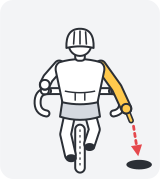 | Point down at the road with your hand or finger on the side of the obstacle | Pothole, bump, glass, rock |
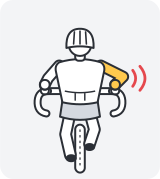 | A few flicks of the elbow on one side | Same obstacle on that side, when you can't take your hand off the bars |
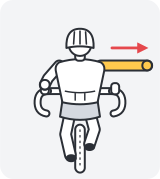 | Arm straight out to the side | Turning that way |
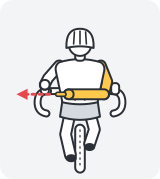 | Hand behind your back, elbow bent at 90°, palm or finger pointing to the side | Moving over to go around an obstacle or a parked car |
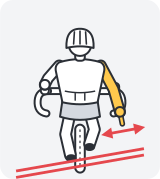 | Hand pointing down at the ground, sweeping parallel to it a few times | Rails or a speed bump; the hand shows which way they run |
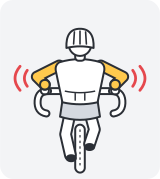 | A few flicks of both elbows | I'm getting out of the saddle, or there's a small obstacle ahead that you can't go around |
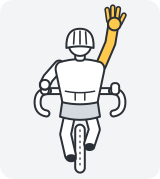 | Raised hand or open palm facing back | Slowing down or stopping |
Out loud. We usually shout in Russian, so here are the words you'll hear:
- «Яма!» (yama), «Стекло!» (steklo), «Говно!» (govno) - hole, glass, shit: obstacle on the road;
- «Тачка сзади!» / «Тачка спереди!» (tachka szadi / tachka speredi) - car back / car up: tighten up and move right;
- «Стоп!» (stop) - we're stopping;
- «Прокол!» / «Пробитие!» (prokol / probitie) - flat: someone has a problem, the group slows down.
The riders at the front point out obstacles early and go around them with room to spare, so nobody behind gets a surprise. Harmless stuff that'll just give you a little shake doesn't get pointed out: if you signal every crack in the road, nobody will notice the real pothole.
Taking turns
In short:
- We always pull off to the left.
- The rider pulling off is responsible for getting out of the way: move left, drift back along the group and latch onto the last wheel.
- The rider taking over at the front keeps the same speed as before, otherwise everyone behind has to chase you. If you want to go a bit faster or slower within the ride's format, wait until the riders who pulled off have tucked in at the back, and change speed gradually.
Two abreast, we rotate in pairs, and both riders pull off to the left. For that the rider on the right has to speed up a little and get slightly ahead of their partner, then both move left, ease off and drift back to the tail. At the back the pair swaps sides: whoever was on the left goes right, and vice versa.
No legs for a pull? No big deal, you don't have to do a full one. But since you've ended up at the front, hang in there for at least ten seconds or so and then pull off as usual. Don't let the previous leader back in ahead of you: it's easy to crash in that shuffle, and it costs you more energy than the pull itself, because first you drop back and then you have to chase back on. Besides, the best place to sit in is the middle of the group, not the very back: that's where the draft is strongest.
Climbs and descents
On climbs the group splits up anyway, and everyone rides their own pace. We usually regroup at the top of long climbs and after long descents, but where and when we wait for each other is stated in the announcement or agreed with the ride leader.
On descents, leave a bigger gap: you're going faster and your braking distance is longer. No overtaking in corners, no cutting corners, no drifting into the oncoming lane.
Eating and drinking
You can eat and drink in the group, but without changing your line or speed. First make sure there are no maneuvers or potholes coming up in the next few seconds, and only then take a hand off the bars. Wrappers go back in your pocket.
If you drop a bottle, don't slam on the brakes or turn around for it in the middle of the group. Shout, calmly drift to the back, and go back for it when it's safe.
Flats and mechanicals
Shout «Прокол!» (prokol) or «Пробитие!» (probitie), meaning "flat", raise your hand and ease over to the side of the road without braking hard. The group will slow down and stop somewhere safe.
We usually wait for flats. But if the ride is on a tight schedule, the ride leader may decide to keep going. Then anyone who fancies a break can stay behind and keep you company.
Pace in announcements
Ride announcements show the pace in moons. The speed in the table is the average for the whole loop on a flat route. But the moons are still about the general vibe, not exact numbers: if the route has hills, it'll obviously be harder.
| Moons | What it means |
|---|---|
| 🌗🌚🌚 | No-drop: nobody gets left behind, anyone can handle it. Almost never happens in practice |
| 🌝🌚🌚 | Total chill: 25-30 km/h average, maybe even lower, depending on who shows up |
| 🌝🌗🌚 | Somewhere between chill and "moderately spicy" |
| 🌝🌝🌚 | Moderately spicy: 30-31 km/h average, counting wind, town traffic and so on |
| 🌝🌝🌗 | Somewhere between "moderately spicy" and a hammerfest |
| 🌝🌝🌝 | Hammerfest with a rotating paceline, 32+ km/h average |
Sometimes instead of moons the announcement just gives an average speed, as a single number or a range, like "28-30".
The ride leader is in charge of the pace. On the road they can dial it down or up within reason, depending on who showed up and how the group is riding.
If you're falling behind
No-drop isn't guaranteed unless the announcement says so. So be realistic about your fitness and pick rides that suit you. If you feel you can't keep up, tell the ride leader early, not after you've already been dropped. And it's a good idea to have the route loaded on your bike computer so you don't get lost.
Stops
When we stop, the whole group gets completely off the road. Standing around in the lane in a crowd, discussing where to go next, is a no. After a stop, don't rocket off - roll out easy and give everyone time to tuck in.
If someone crashes
- Shout «Стоп!» (stop) and stop, without causing a pile-up behind you.
- Someone goes back up the road to warn cars.
- Don't lift or move the rider who went down until it's clear they're OK. The exception is if they're lying where a car could hit them.
- If help is needed, call an ambulance. In Serbia, ambulance is 194, police is 192. The general 112 number doesn't work here.
Before you head out
- helmet, lights charged;
- tires pumped, brakes working;
- tube, pump, multitool;
- water and food;
- phone, card and some cash;
- route loaded on your bike computer;
- announcement read.